
About CSIR-SARI
The Savanna Agricultural Research Institute is one of the 13 research institutes of the Council for Scientific and Industrial Research (CSIR), Ghana. Our mandate is to provide farmers with technologies that improve their farming and their livelihoods.
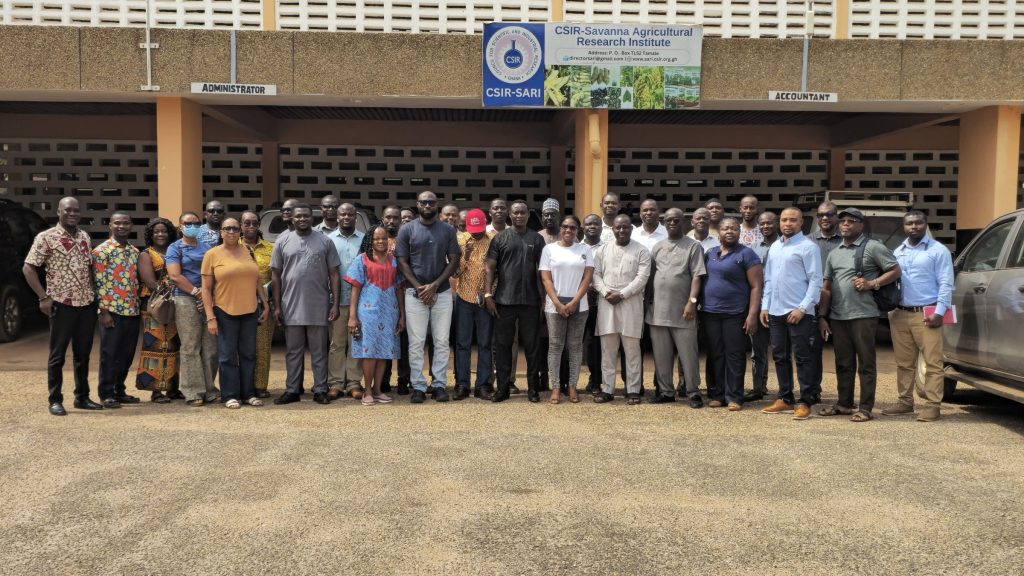
From an experiment station to a centre for savanna agriculture
We began as the Nyankpala Agricultural Experiment Station, an outpost of the Crop Research Institute in Kumasi. Today we serve farmers across Ghana’s five northern regions.
- Early yearsNyankpala Agricultural Experiment Station operates as an outpost of the CSIR-Crop Research Institute, Kumasi.
- June 1994Upgraded to a full institute and renamed the Savanna Agricultural Research Institute.
- July 2024Releases Songotra-T, Ghana’s first genetically modified cowpea, resistant to the Maruca pod borer.
- TodayOur Technology Park at Nyankpala showcases 74 technologies across 10 crop areas, open to farmers and partners all year.
To be the centre of excellence in agricultural research, innovation and development for enhanced food security and livelihoods in the Savanna Zone and beyond.
To conduct agricultural research in northern Ghana to develop and introduce improved technologies that enhance farm-level productivity for improved livelihoods.

Our work begins and ends with the farmer. Every variety we release and every practice we recommend starts as a problem a farmer brought to us.
Welcome to CSIR-SARI. For more than three decades as a full institute, we have served farmers across Ghana’s five northern regions, where erratic rainfall, poor soils, pests and Striga make farming hard. Through our Farming Systems Research approach, our scientists work with farmers on their own fields to develop solutions that fit the savanna.
Recent milestones show what this partnership can achieve. In 2024 we released Songotra-T, Ghana’s first genetically modified cowpea, which protects crops from the Maruca pod borer with far fewer sprays. Our Technology Park at Nyankpala now showcases 74 technologies across 10 crop areas, and we have earned international certification under Excellence Through Stewardship for responsible research.
We invite farmers, seed producers, agribusinesses, students, policymakers and development partners to visit us, use our technologies and work with us. Together, we can build a food-secure and prosperous savanna.
Research groups and support units
Our research follows the Farming Systems Research approach: participatory and bottom-up, with most trials on farmers’ fields. The Director chairs an Internal Management Committee that oversees our research groups and support units. A Management Board provides governance.
Northern Region Farming Systems Research Group
Based at the Nyankpala head office, it runs on-farm research with farmers across the Northern Region.
Upper East Farming Systems Research Group
Based at Manga near Bawku, it adapts technologies for the drier Sudan Savanna of the Upper East.
Upper West Farming Systems Research Group
Based at Wa, it tests varieties and practices with farmers across the Upper West Region.
Scientific Support Group
Based at Nyankpala and working mostly on-station, it supplies the core science behind new varieties and practices.
Finance
Manages the institute’s accounts, budgets and financial reporting.
Documentation, Library & Communication
Edits and publishes reports, handles correspondence, and coordinates exhibitions, seminars and field visits.
Research where farmers farm
Nyankpala, Northern Region
- Location
- 16 km west of Tamale
- Zone
- Northern Guinea Savanna
- Rainfall
- Over 1,000 mm a year, one season (April–October)
- Altitude
- 200 m above sea level
Manga, Upper East Region
Near Bawku in the Sudan Savanna. Home of our pearl millet and sorghum breeding and Frafra potato research, with its own technology park for farmers in the eastern corridor.
Wa, Upper West Region
Runs participatory selection of cowpea and stress-tolerant maize with farmers, plus soil fertility, agroforestry and livelihood projects across the Upper West.