


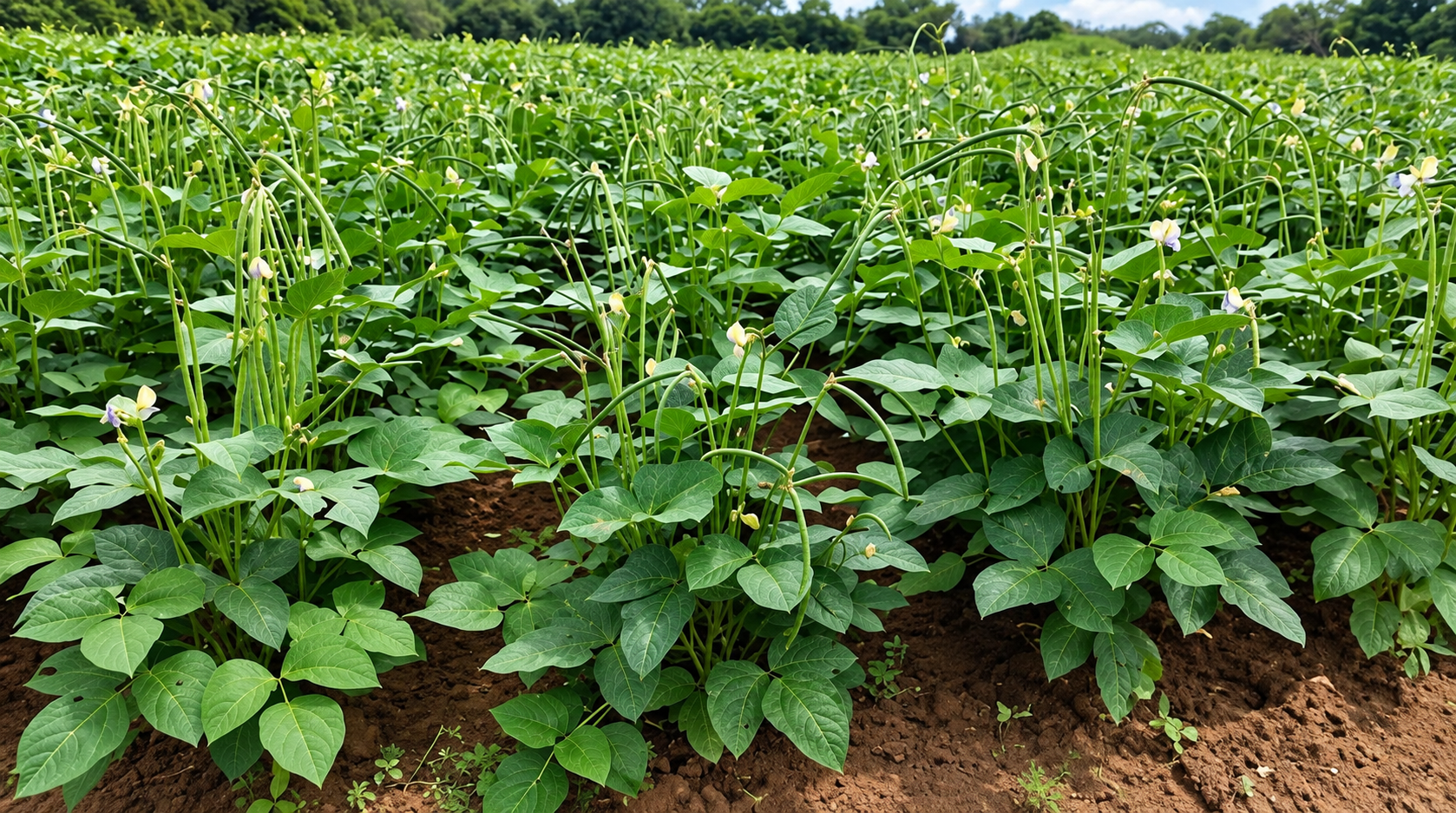
 A new study led by scientists from the Council for Scientific and Industrial Research–Savanna Agricultural Research Institute (CSIR-SARI) in Ghana has identified promising cowpea genotypes with the potential to strengthen climate resilience and improve grain yield stability under recurrent drought conditions.
The study, published in BMC Plant Biology, examined how twenty cowpea genotypes respond to recurrent intermittent drought—one of the growing threats to rainfed agriculture across sub-Saharan Africa. The research was led by Dr. Theophilus Kwabla Tengey of CSIR-SARI, in collaboration with Sanatu Mustapha Alidu and Francis Abbas Senyabor of the University for Development Studies.
Unlike conventional drought studies that expose crops to a single prolonged period of water stress, the researchers simulated the stop-start drought conditions increasingly experienced by farmers. The experiment subjected cowpea plants to two ten-day water-withholding cycles during the critical flowering and podding stages, separated by a recovery period.
The results revealed significant differences in how the genotypes responded to water stress. While average grain yield declined by 13.2 percent under recurrent intermittent drought, some genotypes demonstrated remarkable resilience and even improved their performance under stress.
One genotype, IT17K-849-2-1, recorded a 10.4 percent increase in grain yield under drought conditions compared with its performance under well-watered conditions. The researchers linked this exceptional response to higher chlorophyll retention and lower canopy temperatures, suggesting that the genotype was able to maintain photosynthetic activity and efficient water use during periods of stress.
Another genotype, IT17K-1367-2-3, recorded the highest grain yield under drought conditions, producing 1,492.5 kilograms per hectare while experiencing only a 3.3 percent yield reduction compared with its performance under favourable water conditions.
The study also identified IT17K-1095-2-2 and UDS-CRs-F20-2 as highly stable genotypes across different environments. Their consistent performance is particularly important for smallholder farmers, who require crop varieties capable of producing reliable yields despite increasing climate variability.
Early Maturity and Physiological Resilience Key to Drought Adaptation
The findings further showed that early maturity plays an important role in helping cowpea plants escape drought. Genotypes that reached pod maturity earlier generally recorded higher yields under drought conditions.
However, the researchers found that drought adaptation is not determined by early maturity alone. The most resilient genotypes combined several important characteristics, including early maturity, chlorophyll retention, cooler canopy temperatures and efficient water-use dynamics.
The study therefore recommends the integration of physiological traits such as canopy temperature and chlorophyll retention into cowpea breeding programmes. These traits can be measured relatively quickly in the field and could help breeders identify drought-resilient materials at earlier stages of crop improvement.
Implications for Climate-Resilient Agriculture
The findings come at a critical time for agriculture in West and Central Africa, where climate change is increasing the frequency of erratic rainfall, prolonged dry spells and rising temperatures.
Cowpea remains one of Africa's most important grain legumes, providing food, income, livestock feed and soil fertility benefits for millions of smallholder farming households. However, recurrent drought continues to limit productivity across the dry savannas.
The researchers believe the elite genotypes identified in the study could serve as valuable parents in breeding programmes aimed at developing new climate-resilient cowpea varieties.
The research also demonstrates the importance of evaluating crops under realistic field conditions that reflect the multiple drought episodes farmers increasingly experience during a growing season.
Supported in part by the Bill & Melinda Gates Foundation through the Accelerated Varietal Improvement and Seed Delivery of Legumes and Cereals in Africa project, the research involved collaboration with the International Institute of Tropical Agriculture (IITA) and ICRISAT.
For African agricultural research and development, the findings provide encouraging evidence that valuable drought-resilience traits already exist within available cowpea germplasm. The next challenge will be to translate these scientific discoveries into improved varieties and deliver them to farmers across drought-prone production systems.
Article Reference:
Tengey, T. K., Alidu, S. M., & Senyabor, F. A. (2026). Grain yield stability and trait-based dissection of recurrent intermittent drought adaptation in cowpea under contrasting water regimes. BMC Plant Biology. DOI: 10.1186/s12870-026-09908-6.