
Nyankpala, Oct. 26 – The CSIR-Savanna Agricultural Research Institute (CSIR-SARI) has begun testing eight fertiliser treatments to find out whether Enhanced Efficiency Fertilisers (EEFs) can help maize farmers get the same or better yields while using less nitrogen.
Besides raising yields, the trials aim to improve soil health and cut the nitrogen that is lost to the environment through runoff and greenhouse gas emissions.
Farmers from Nyankpala, Kpalsogu, Tingoli, Kpana and Preguyili saw the trials at a field day on CSIR-SARI’s experimental field at Nyankpala, where they were introduced to the treatments, the fertiliser sources and the best ways to apply them.
What is being tested
Dr Edwin Korbla Akley, Senior Research Scientist (Soil Microbiology, Soil Health and Agroecology), Head of CSIR-SARI’s Soil Science Programme and Co-Principal Investigator of the project, said the trials compare conventional urea with EEFs treated with nitrification inhibitors and with organic amendments such as Super Gro and organic seaweed combined with urea.
The treatments include Super Urea, Kynoch Plus Urea, Anvol with Yara Urea, organic seaweed with Yara Urea, Super Gro with Yara Urea, Yara Urea alone, and a control plot that receives no fertiliser.
The team is comparing the standard rate of 90 kilogrammes of nitrogen per hectare with a rate 20 per cent lower, 72 kilogrammes per hectare, to see whether the improved products can maintain or raise yields with less fertiliser.
A parallel trial is testing mineral phosphorus from Triple Super Phosphate alongside biological phosphorus from arbuscular mycorrhizal fungi, combined with EEFs, urea and organic amendments.
Getting more from every bag of fertiliser
Dr Akley explained that much of the nitrogen farmers apply is lost through ammonia volatilisation, leaching and microbial processes, so less reaches the crop and some of it harms the environment.
He stressed the 4Rs of nutrient stewardship: applying the right fertiliser source, at the right rate, at the right time and in the right place.
The researchers are aiming for yield gains of 20 to 35 per cent, although results will only be confirmed as the multi-season trials progress. They are also measuring nitrogen losses and emissions of nitrous oxide, a potent greenhouse gas.
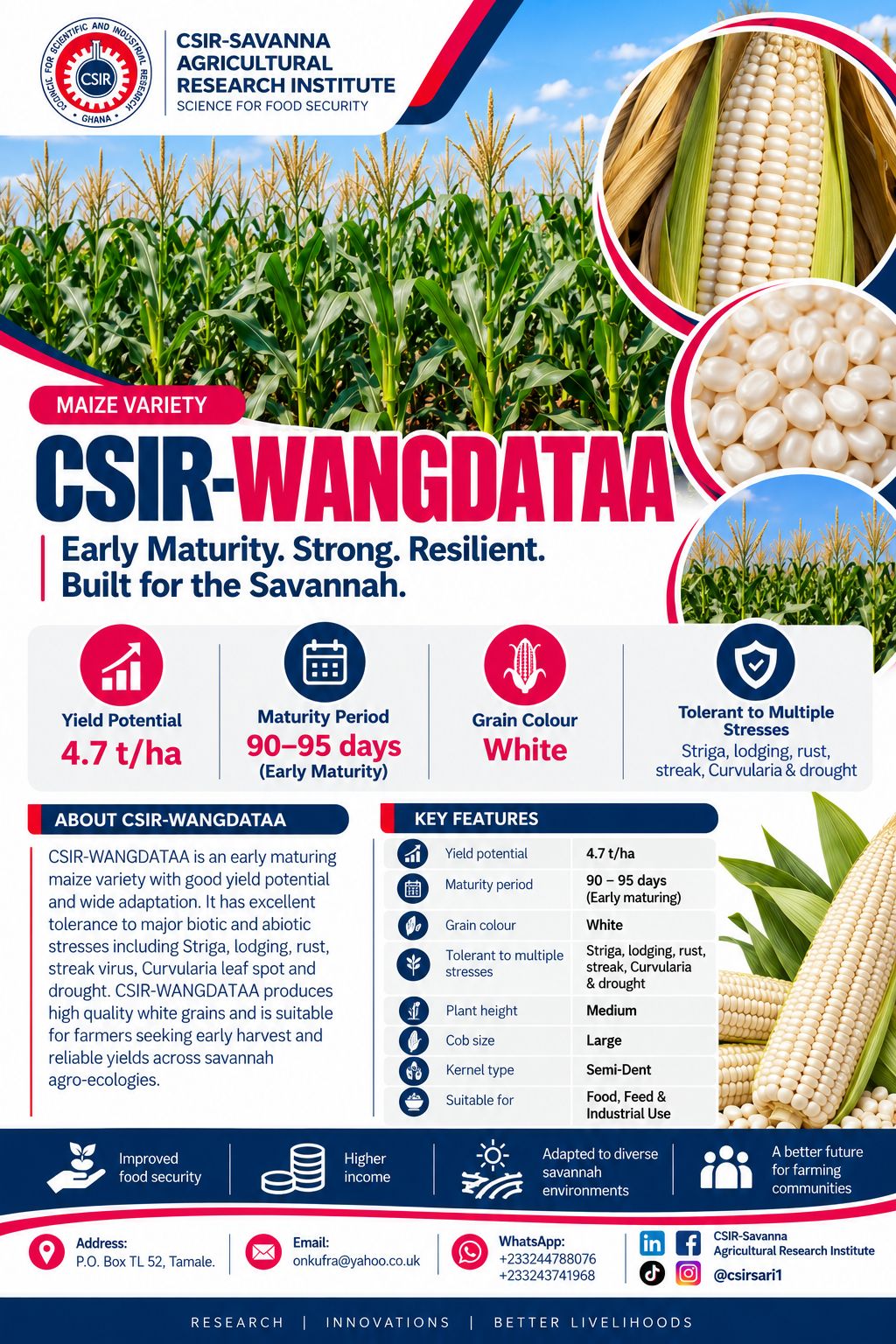
To cope with shorter rainy seasons, the trials use Wang Dataa, CSIR-SARI’s 90-day early-maturing maize variety.
From station to farmers’ fields
Dr Akley said the three-year project takes a participatory approach. After the initial trials, the team will pick the four best treatments for on-farm testing with farmers before any commercial roll-out. The study will also look at maize-soybean rotation and millet as a cover crop to improve soil health and use leftover nitrogen.
The project is a partnership between CSIR-SARI and the University of Tennessee in the United States, funded by the Foundation for Food and Agriculture Research through the Enhanced Efficiency Fertilizer Consortium.
Farmers at the field day were keen on the new products. Mr Mohammed Sibdow Wunibiyeli, a farmer from Kpalsogu, said he would buy EEFs once they reach the market, provided the extra cost is justified by higher maize yields, and would share what he learnt with his community.
Madam Maria Rose Sumani, a farmer from Nyankpala, said the demonstration helped her understand the different fertilisers and the importance of applying them correctly.
Adapted from a report by the Ghana News Agency (GNA).
Leave a Reply